

Interference and limitations in daily activities
Sleep Disorders
Affordable price
Decline in quality of life
What is an allergy?1
An allergy is a hypersensitivity or an exaggerated response by the immune system to substances in our environment (such as pollen, dust mites, or foods) that do not pose a threat to us. This immune imbalance is associated with a series of inflammatory reactions in various organs and mucous membranes throughout the body, which give rise to the various symptoms and signs of allergic diseases. There are immediate and delayed hypersensitivity reactions; immediate reactions (mediated by IgE antibodies) are the most common.
Among the various allergic conditions that exist, the term “dermatitis” is used when inflammation affects the skin, “conjunctivitis” when it occurs in the conjunctiva of the eye, “rhinitis” when it affects the nasal mucosa, and “asthma” when inflammation affects the bronchi.
What causes allergies?2
The agents that cause allergic diseases are called allergens. These can be defined as harmless substances that trigger hypersensitivity reactions in susceptible individuals.
They cause illnesses through inhalation and subsequent contact with the respiratory tract (asthma, rhinitis) and/or the conjunctiva of the eye (conjunctivitis). The most common airborne allergens are pollen, fungal spores, dust mites, and pets.
They cause immediate reactions upon consumption, with the onset of digestive, respiratory, and/or skin symptoms. The most common allergens in children are milk and egg proteins, while in adults, fruits and shellfish are the most common. Allergies to parasites that contaminate food—such as an allergy toAnisakis simplexlarvae in fish—are also considered food-borne.
They cause skin reactions upon contact with the skin for a more or less prolonged period, manifesting as eczema or dermatitis. The most common contact allergens are metals (especially nickel) and certain topical medications.
These include medications, latex, and hymenoptera venom (bees and wasps).
What are the different types of allergy tests, and how are they performed?3
In clinical practice, the etiological diagnosis of allergy is made based on the patient’s medical history, supplemented by allergy testing. Allergy testing includes skin tests andin vitromeasurements of specific IgE levels, which indicate sensitization—that is, the presence of specific IgE antibodies against the airborne allergen.
As for skin tests, various types of skin tests can be performed, depending on the specific allergic disease and the type of allergic reaction suspected (immediate or delayed).
Prick test
It is the most common and widely performed allergy test. It is used to diagnose immunoglobulin E (IgE)-mediated allergies, also known as immediate hypersensitivity reactions.
To perform the test, a drop of the allergen extract to be tested is placed on the front of the forearm, and a slight prick is made with a lancet through the drop of extract and the outermost layer of the skin (epidermis). The result is obtained within a few minutes.
A variation of this test is the "prick-by-prick" test: it involves pricking the substance in its natural state (such as a piece of fruit) with a lancet and then pricking the skin with the same lancet.

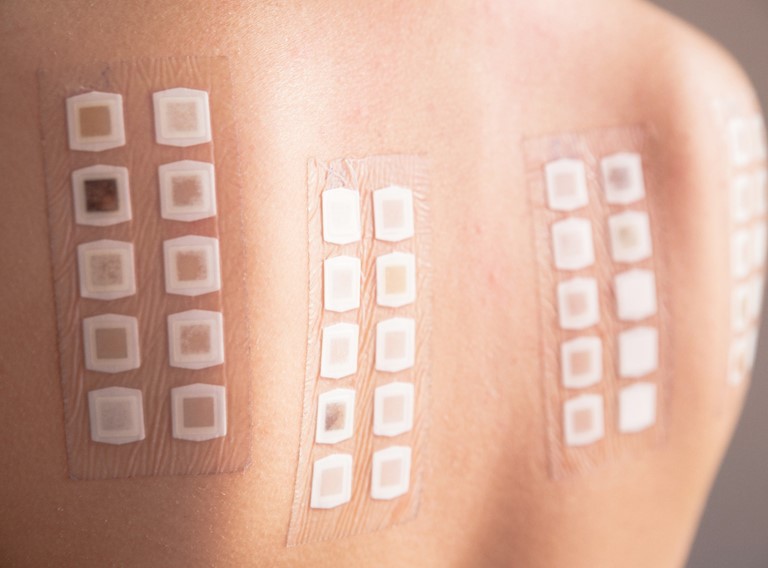
Skin test
It is the most important factor when studying certain allergic skin diseases, such as allergic contact dermatitis (allergic eczema), or certain drug reactions.
The substance is usually mixed with petroleum jelly and applied to the skin using special dressings or polyethylene patches, keeping the substance in contact with the skin for several days. After 48 hours, the patches are removed and the reaction is assessed. At 96 hours, without washing the area, a final assessment is made.
Intradermal test
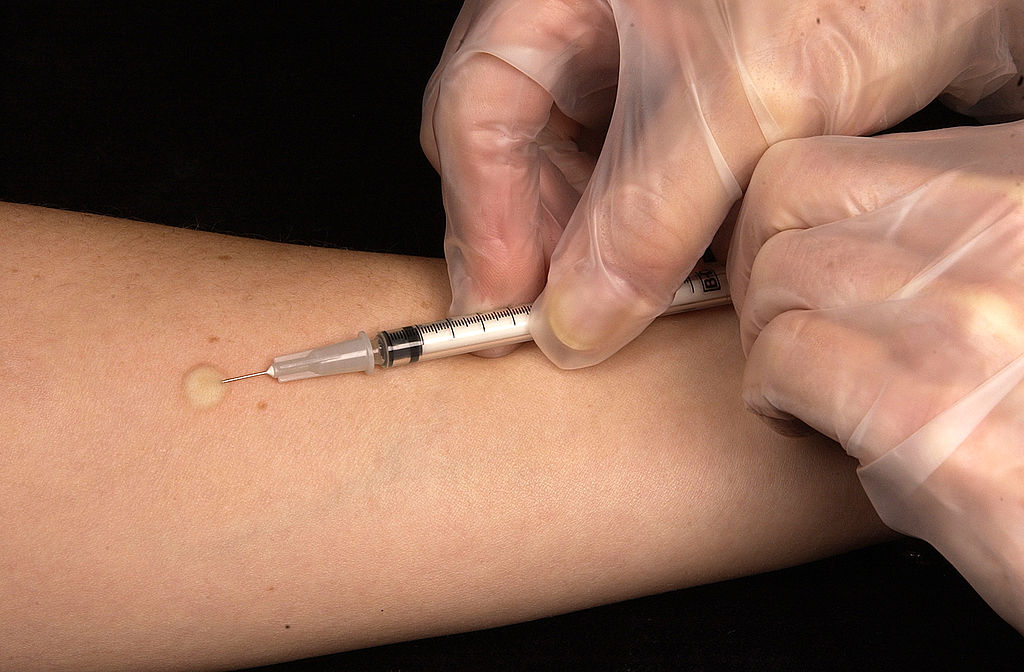
A more expensive and time-consuming test. For certain allergens (hymenoptera venom, medications, or people with mild sensitivity), the prick test is not sufficient. In these cases, intradermal tests are recommended (they are more sensitive).
It involves injecting the extract directly into the second layer of the patient’s skin (the dermis), and the result is read after 15–20 minutes. It is also useful for investigating delayed-type hypersensitivity; the result must be read at 24, 48, and 96 hours.
1. Chivato Pérez, T. “What Is an Allergy? What Does Allergology Study?” In: José Manuel Zubeldia, Mª Luisa Baeza, Ignacio Jáuregui, Carlos J. Senent. BBVA Foundation Book on Allergic Diseases. 1st ed. Bilbao: Editorial Nerea, S.A.; 2012. pp. 21–30.
2. SEAIC: Spanish Society of Allergology and Clinical Immunology (cited on October 10, 2010). URL: https://www.seaic.org/pacientes/conozca-sus-causas
3. Parra Arrondo, A. Skin tests. In: José Manuel Zubeldia, Mª Luisa Baeza, Ignacio Jáuregui, Carlos J. Senent. The BBVA Foundation’s Book on Allergic Diseases. 2nd ed. Bilbao: Editorial Nerea, S.A.; 2012. pp. 365–370.